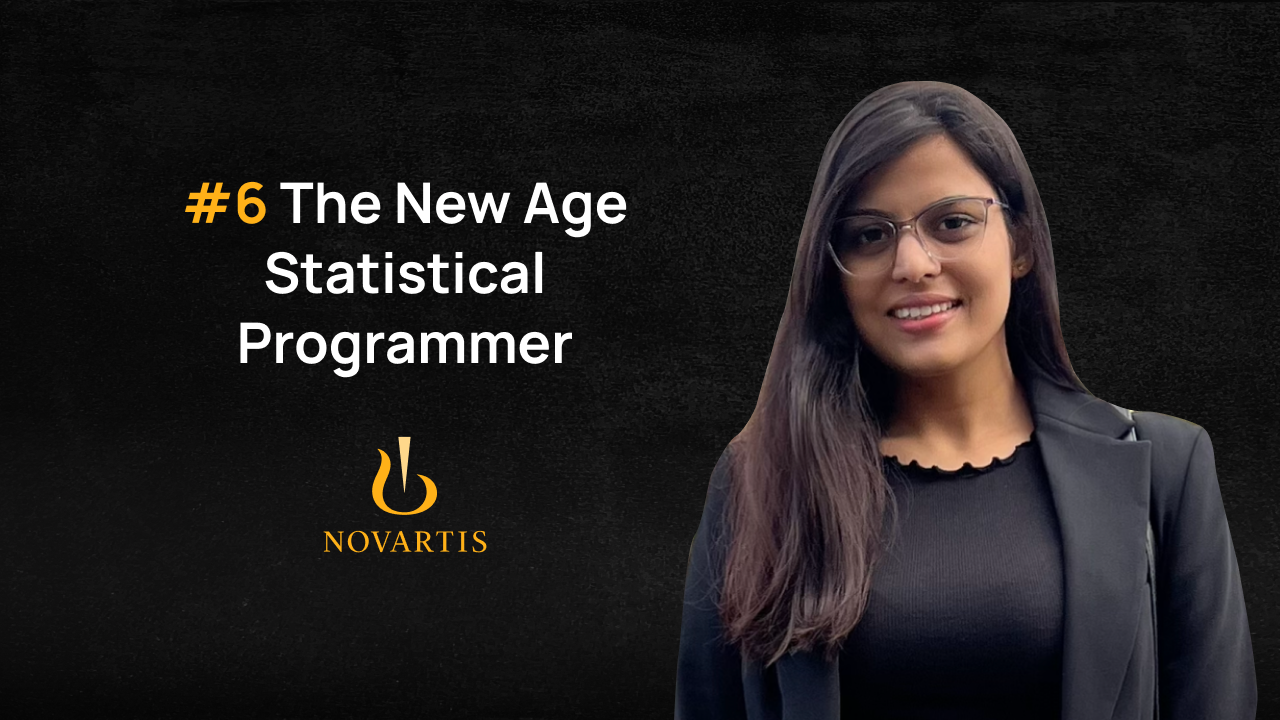
In this Verisian Community Podcast episode, we welcome Ritika Aggarwal from Novartis, who shares insights on the evolving landscape of statistical programming. Addressing challenges like data complexity and the rise of AI, Ritika frames these as opportunities for innovation. We touch on the industry's adaptation to the "new normal," the crucial role of continuous learning for programmers, and the importance of staying updated with changing clinical data standards. Ritika's experiences offer a deep dive into the dynamic field of statistical programming, highlighting the potential for professional growth and the overall advancement of the industry.
Key Takeaways
Ritika Aggarwal frames ongoing industry disruption as a "new normal," drawing a direct parallel to COVID-era adaptation: rapid changes in data collection, regulatory guidance, and submission processes are a permanent condition to adapt to, not a temporary phase to wait out.
She credits roughly 30% of her professional learning to her time contributing to the Admiral (admiralonco) open-source R package project, which also taught her GitHub from scratch and connected her to a global cross-company network she later recognized in person at PHUSE conferences.
Her approach to staying current with evolving CDISC standards is community-based rather than solitary: joining PHUSE working groups, attending conferences (PHUSE EU Connect twice), and treating industry knowledge-sharing as essential rather than optional, alongside deep, hands-on study of implementation guides.
She predicts the field's future runs on multiple programming languages rather than any single one prevailing, based on her master's experience using Python for sequence-based genomic data and R for tabular data, and expects language choice to increasingly follow what best fits a given dataset rather than industry convention.
Asked to compare sponsor versus CRO career paths, she leans toward CROs as offering broader early-career exposure (multiple projects, teams, and therapeutic areas at once) versus a sponsor's narrower but deeper growth track, while noting the right path is highly individual.
Episode Info
Guest: Ritika Aggarwal, statistical programmer at Novartis, background in bioinformatics and biotechnology (master's); PHUSE EU Connect speaker and published paper author; former active contributor to the Admiral (admiralonco) open-source R package project.
Host: Tomás Sabat Stöfsel, CEO & Co-Founder, Verisian
Topics: Path into statistical programming from bioinformatics, the "new normal" framework for industry disruption, cultural challenges of adopting new technology inside regulated organizations, staying current with evolving CDISC standards through community and conferences, experience contributing to the Admiral project, predictions for R, SAS, and Python's future roles, sponsor versus CRO career paths for early-career programmers
From Bioinformatics to Statistical Programming, "By Chance"
Ritika's path into the field began during a bioinformatics and biotechnology master's program that combined core biology research with heavy computational training across languages including C, Python, R, and C++. She describes landing at Novartis through campus placement as something that happened by chance rather than a planned trajectory, but says what's kept her in the role is the sense of being one link in a chain that ultimately gets a needed drug to a patient, combined with genuinely enjoying the programming itself and being part of decisions that carry real-world impact.
The "New Normal": Treating Constant Change as the Baseline, Not an Exception
Ritika's central framework, drawn from a paper and talk she gave at PHUSE EU Connect, compares the industry's current wave of disruption — changing data types, evolving regulatory guidance, shifting submission expectations, faster drug-development timelines — to the collective adaptation the world underwent during COVID. Her point isn't that any single change is unprecedented, but that treating rapid, continuous adaptation as the new baseline condition, rather than a temporary disruption to wait out, is what lets an individual or organization actually keep pace. She's candid that different generations within the industry will need different paths to get there, and that the field is still actively working out what those solutions look like.
Staying Current Is a Community Sport, Not a Solo One
Asked how newer programmers should keep up with evolving CDISC standards, Ritika distinguishes between two separate skills: the technical tooling (which younger programmers often already have from their education) and actually understanding the standards themselves, which she says takes sustained, hands-on effort, sitting with the data, mapping it against IGs and guidance documents, and revisiting them regularly. But her primary strategy is community-based: joining PHUSE working groups, attending conferences (she's attended PHUSE EU Connect twice), and treating cross-company networking as essential to understanding not just how her own team does things, but how the wider industry is evolving. She frames conference attendance as a two-way diagnostic: seeing how others solve a problem tells you both whether your own approach is ahead of the curve and worth building on, or behind it and worth learning from.
The Value of Shared Industry Resources And the Importance of Industry Collaboration
Ritika describes her time contributing to the Admiral (admiralonco) project as disproportionately formative, crediting it with roughly 30% of her overall professional learning despite a relatively short tenure on the project. Beyond the standards and programming knowledge itself, it was her first exposure to GitHub, and she highlights the unusual experience of a standard being built collaboratively by people from different companies and backgrounds working toward a shared industry resource, something she found genuinely rare in a normally competitive industry. She later recognized many Admiral collaborators in person at PHUSE conferences, describing the resulting sense of community as a source of real day-to-day motivation. She has since stepped back from active Admiral contribution due to competing project demands but says she intends to return.
Why Ritika Doesn't Think Any Single Language Wins
Asked to predict where R is headed, Ritika resists the framing itself, arguing the industry's future isn't R, SAS, or Python individually but a broader mix of languages chosen for fit with the data rather than convention. She draws on her own master's experience using Python for sequence-based genomic data and R for tabular data as an early illustration of language-by-task fit, noting Python's growing tabular capabilities (via pandas) are already blurring that old divide. Her broader point, echoed by conversations she had with other statistical computing environment (SCE) practitioners at PHUSE, is that the industry's language mentality should shift from "what's popular" to "what works best for this dataset and this regulatory presentation."
Sponsor or CRO?
Asked how early-career programmers should think about sponsor versus CRO paths, Ritika is upfront that her direct experience is sponsor-side (Novartis), though she's worked closely with CRO colleagues whose depth of process knowledge she describes as impressive. Her general read is that sponsors offer the ability to specialize deeply within a chosen part of the process, while CROs tend to expose programmers to a wider range of projects, teams, and therapeutic areas simultaneously, which she personally values for accelerating broad-based growth, while acknowledging the right choice depends entirely on an individual's goals.
Notable Quotes
"There are a lot of changes happening... changes in the data, changes in the regulatory guidelines, changes in how are we submitting the data, how are we looking at the data, changes in how fast do we come up with a drug." — Ritika Aggarwal
"I would say 30% of my learning has come out of that project [Admiral]... people are coming from different backgrounds, different industries, coming together, working on something that's gonna be a standard across the industry, which is not very common." — Ritika Aggarwal
"It shouldn't be just one language, should be what's working best for the data and what's working best for what are you presenting to the regulatory authorities." — Ritika Aggarwal
"The best way to do anything about these challenges is to come together as a community, work together, and find solutions." — Ritika Aggarwal
"Continuous learning in a community is the best thing that we can do in order to be present in the new era of working." — Ritika Aggarwal
FAQ
What does Ritika Aggarwal mean by the "new normal" in clinical programming?
A framework comparing the industry's current pace of change — in data types, regulatory guidance, and submission processes — to the collective adaptation required during COVID, arguing that treating continuous change as the baseline condition, rather than a temporary disruption, is what allows individuals and organizations to keep up.
How did contributing to the Admiral project shape Ritika's career?
She credits it with roughly 30% of her overall professional learning, her first exposure to GitHub, and a global cross-company network she later recognized in person at PHUSE conferences, describing it as a rare example of genuine cross-industry collaboration on a shared standard.
Does Ritika think R will become the dominant language in clinical programming?
No. She predicts the field's future involves multiple languages chosen by fit with the specific dataset (citing her own master's-era use of Python for genomic data and R for tabular data) rather than any single language becoming dominant.
How does Ritika recommend newer programmers stay current with CDISC standards?
Through a combination of hands-on study (mapping data directly against implementation guides and guidance documents) and active community involvement, joining PHUSE working groups, attending conferences, and networking broadly rather than relying solely on day-to-day project work.
Sponsor or CRO: which does Ritika recommend for early-career programmers?
She frames it as a personal decision but leans toward CROs for early-career breadth, since they expose programmers to multiple projects, teams, and therapeutic areas simultaneously, versus a sponsor's typically narrower but deeper specialization track.
About The Verisian Community Podcast
The Verisian Community Podcast brings together experts in clinical trials to exchange innovative ideas and best practices central to clinical reporting, submission and review. Aligned with Verisian's mission to accelerate the evaluation and market launch of new medical treatments, each episode features expert insights, with guests ranging from statistical programmers to medical writers, to discuss the challenges and opportunities of the latest software and technology.